
psychoeducational groups
Join our small groups with tips, tools & moderated discussion in a safe group online environment with registered therapists. All are welcome!
See below for FAQ's.
Sign Up Now!
Or check out the FAQ for
"What topics will be covered each week?"
Sign-Up Here!
About us!
100 Queen Street West
Brampton, ON L6X 1A4
groups@eautherapy.com
-
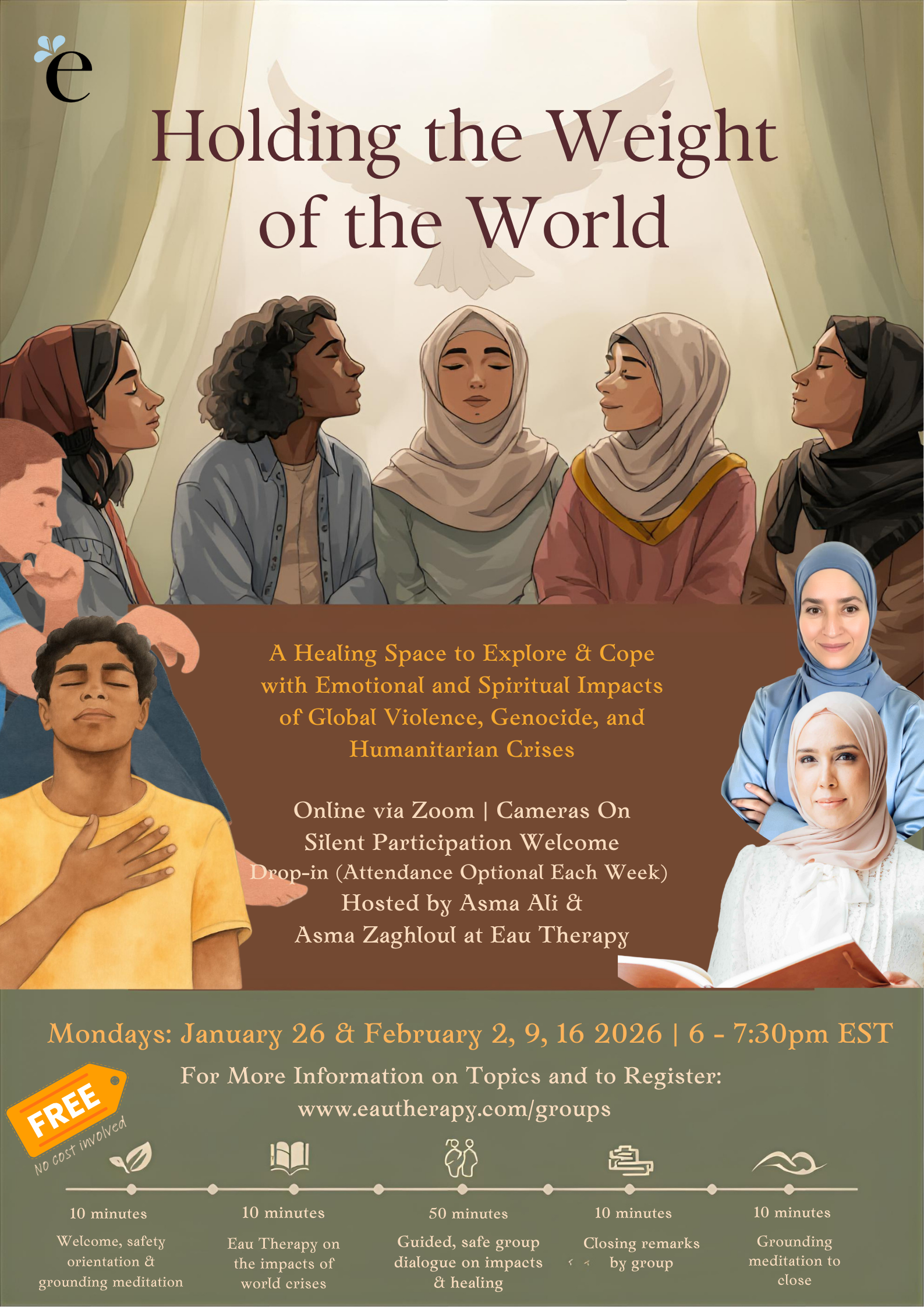
What will happen in each session?
Each session will consist of the following:
1. Welcome and Grounding (10 minutes)
2. Psychoeducation (10 minutes)
3. Guided, Safe Group Dialogue (50 minutes)
4. Closing remarks (10 minutes)
5. Closing meditation
-
Who can participate?
Our groups are for adult (18+) men and women of any background, experience or religion. All are welcome!
-
What's the cost?
It's free! There's no cost.
-
What if I have to miss a session?
No problem! Attendance is up to you.
-
Will the group be private?
The group will include two therapists and a maximum of 10 participants. If participants share personal information, the therapists will hold it in confidence, however it is not guaranteed that participants will do the same. Participants should share with care. The focus is to learn and gain tips and participants can do that without sharing if they wish!
-
Do I have to have my video on?
Yes, to honor the participants in the room, we will ask everyone to participate fully with their video on in a safe, private space.
-
Do I have to be in therapy to join?
No, you don't! Even if you've never tried therapy, you can join. These groups are for everyone!
-
Do I have to share personal information?
No. You'll never be asked to share personal information! However, if you want to, it's up to you. When participants share, therapists will moderate the discussion so that sharing does not trigger others.
-
Can I book a session with one of your therapists?
Yes! Visit eautherapy.janeapp.com to book
-
Can non-Canadians participate?
Yes, non-Canadians can participate! You can participate from anywhere.
-
Can I try out the first session then decide?
Yes, absolutely.
-
How do I get the Zoom link?
Register and then we'll send you the Zoom link.
-
What topics wil be covered?
Week 1: Bearing Witness & the Nervous System
Focus:
What happens in the body and psyche when we witness large-scale suffering
Vicarious trauma vs direct trauma
Why “just stop watching the news” doesn’t work for many people
Key Themes:
Witnessing as a human and moral experience
Trauma exposure through media
Collective trauma in Muslim & BIPOC communities
Intergenerational and historical echoes
Practices:
Nervous system orientation (safety, choice, pacing)
Grounding for people who feel overwhelmed, numb, or hyper-alert
Identifying personal signs of overload
Week 2: Moral Injury, Helplessness & Anger
When the World Violates What We Believe Is Right
Focus:
Moral injury: witnessing injustice without power to stop it
Rage, guilt, despair, shame, and spiritual confusion
“Why am I still living my life while others are dying?”
Key Themes:
Moral pain vs pathology
Survivor guilt & privilege guilt
Faith, conscience, and rupture
Anger as information, not a failure
Practices:
Working with anger safely
Differentiating responsibility from responsibility-taking
Boundary work around news, activism, and emotional exposure
Week 3: Grief, Loss & Disenfranchised Mourning
Grieving What the World Won’t Pause For
Focus:
Collective grief that has no ritual, funeral, or acknowledgment
Grieving people, places, futures, and innocence
How grief shows up differently across cultures
Key Themes:
Disenfranchised grief in Muslim & racialized communities
Complicated grief when loss is ongoing
Trauma vs grief — and where they overlap
The fear of “opening the floodgates”
Practices:
Titrated grief work (without emotional flooding)
Honoring loss without collapse
Personal and cultural grief rituals (optional, non-prescriptive)
Week 4: Staying Human in an Inhumane World
Resilience, Meaning & Sustainable Care
Focus:
How to remain engaged without burning out or shutting down
Reclaiming agency, dignity, and meaning
Moving from survival to conscious living
Key Themes:
Resilience vs numbness
Choosing how we witness
Faith, values, and meaning-making (open, inclusive framing)
Community as regulation
Practices:
Creating a personal “witnessing plan”
Anchors: faith, values, embodiment, community
Identifying what sustains vs depletes